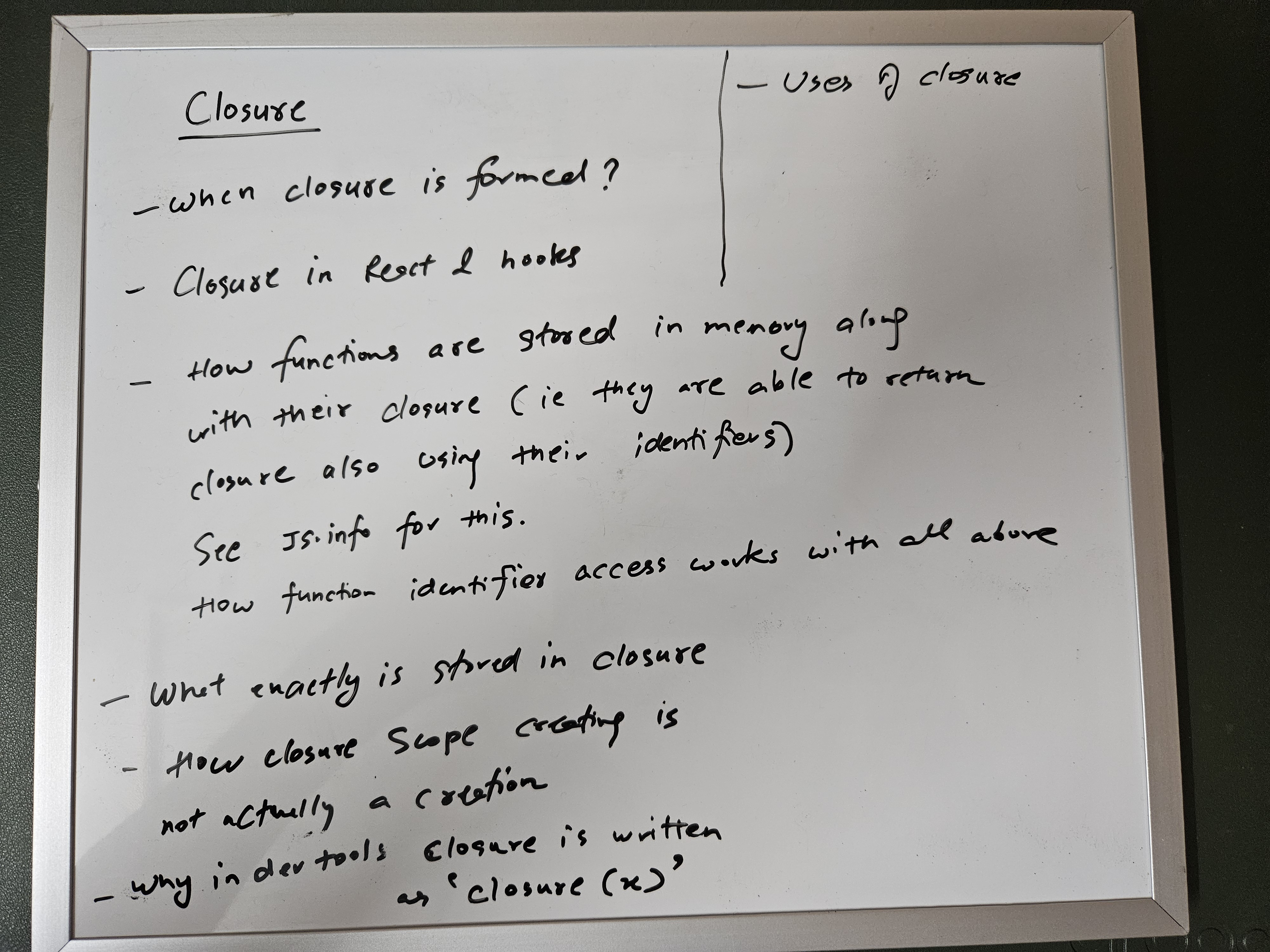
Closure
A function along with its lexical scope (i.e. the variables from the outer function) is called a closure.
function outer() {
  let outerVar = "I am from outer";

  function inner() {
    console.log(outerVar); // Accessing outer variable creates a closure scope
  }

  return inner;
}
const innerFunc = outer();
innerFunc();
Unlike other scopes, Closure scope do not create a special or new type of Lexical Environment, instead:
- The inner function gets its own Lexical Environment when it is executed.
- But it retains a reference to the Lexical Environment of the outer function, even after the outer function has returned.
So the closure scope refers to a preserved outer Lexical Environment — not a separate "closure Lexical Environment"
Closures store the reference to the outer Lexical Environment, not the values of the variables. So if the outer variable changes, the inner function will see the updated value.
for (var i = 0; i < 3; i++) {
  setTimeout(function () {
    console.log(i); // 3, 3, 3
  }, 1000);
}
In the above example, the setTimeout function creates a closure that retains a reference to the outer Lexical Environment. By the time the timeout executes, the loop has completed and i is 3.
To fix this, we can use an IIFE to create a new scope for each iteration:
for (var i = 0; i < 3; i++) {
  (function (i) {
    setTimeout(function () {
      console.log(i); // 0, 1, 2
    }, 1000);
  })(i);
}
How Closures are implemented
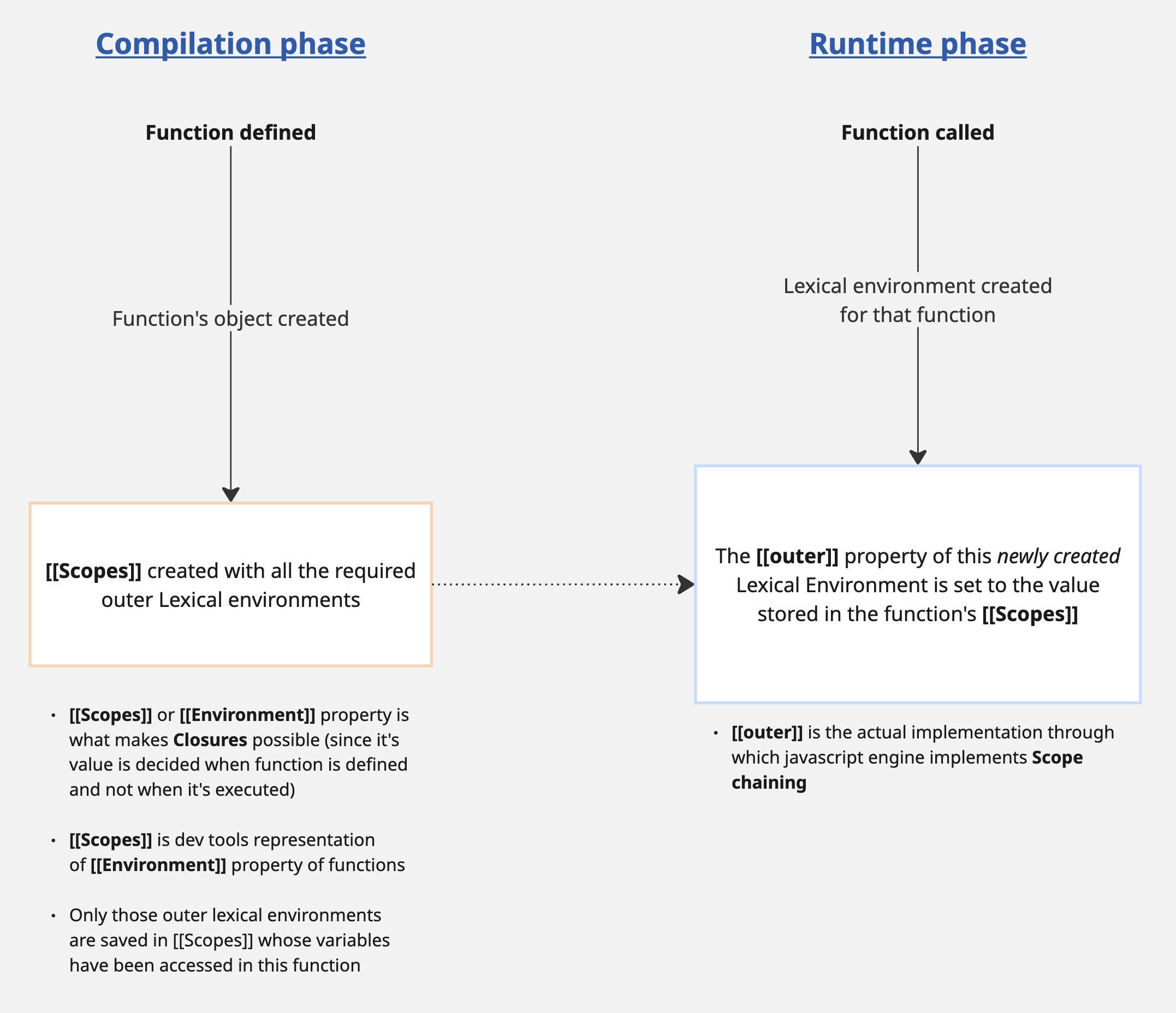
Javascript engines use a special internal property called [[Scopes]] to keep track of the outer Lexical Environment.
Uses of closure:
- Data hiding
- Module design pattern
- Currying
- Functions like Once
- Memoization
- Maintaining State in async world
- setTimeouts
- iterators
Disadvantages of closure:
- Memory leaks
- Event listeners Garbage collection
- Performance issues
- Debugging issues
- Complexity
- Unintentional variable retention
- Garbage collection issues
- Overhead of maintaining scope chain
- Unintentional retention of outer variables
Doubts/To cover
- How IIFE creates a new closure scope?
- Relation between
[[Scopes]]/[[Environment]]&[[OuterEnv]]of lexical environment - How closure is implemented using
[[Scopes]]/[[Environment]]. Give both examples of what is saved in[[Scopes]]when there's a outer variable access vs when there's no outer variable access. - Compile time vs runtime what happens for
[[Scopes]]/[[Environment]]/[[OuterEnv]]. Inner and outer example with JIT compilation. - Why
[[Scopes]]has all the outer scopes present? Shouldn't just outer scope be enough? Also does it only contain outer scope which are closures? Verify this. - What is the significance of order/index of elements in
[[Scopes]]? Which scope is present at first and last and why? - Where in memory is closure stored? How it affects garbage collection and slows down the performance?
References
Notes